
If you search for what to eat in Korea, you’ll probably see the same foods over and over again.
Korean BBQ. Bibimbap. Kimchi. Tteokbokki.
And yes, you should try them. But that’s not really what this list is about.
I live in the U.S., and I go back to Korea almost every summer. Every time I start planning my trip, food is honestly one of the first things I think about.
There are certain foods I miss and want to eat as soon as I get there. Some are very Korean, some aren’t originally Korean at all, and a few might sound a little intimidating if you’ve never had them before.
So this isn’t really a “10 most famous Korean foods” list.
It’s just 10 things I actually eat when I’m back in Korea.
And if you’re visiting for the first time, maybe you’ll find something here that wasn’t already on your list.
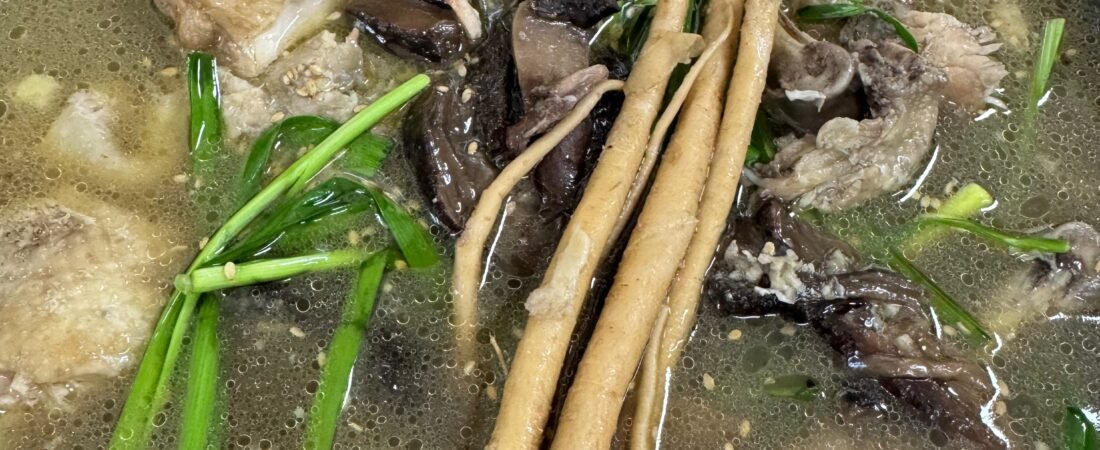
1. Neungi Mushroom Baeksuk (능이버섯 백숙)
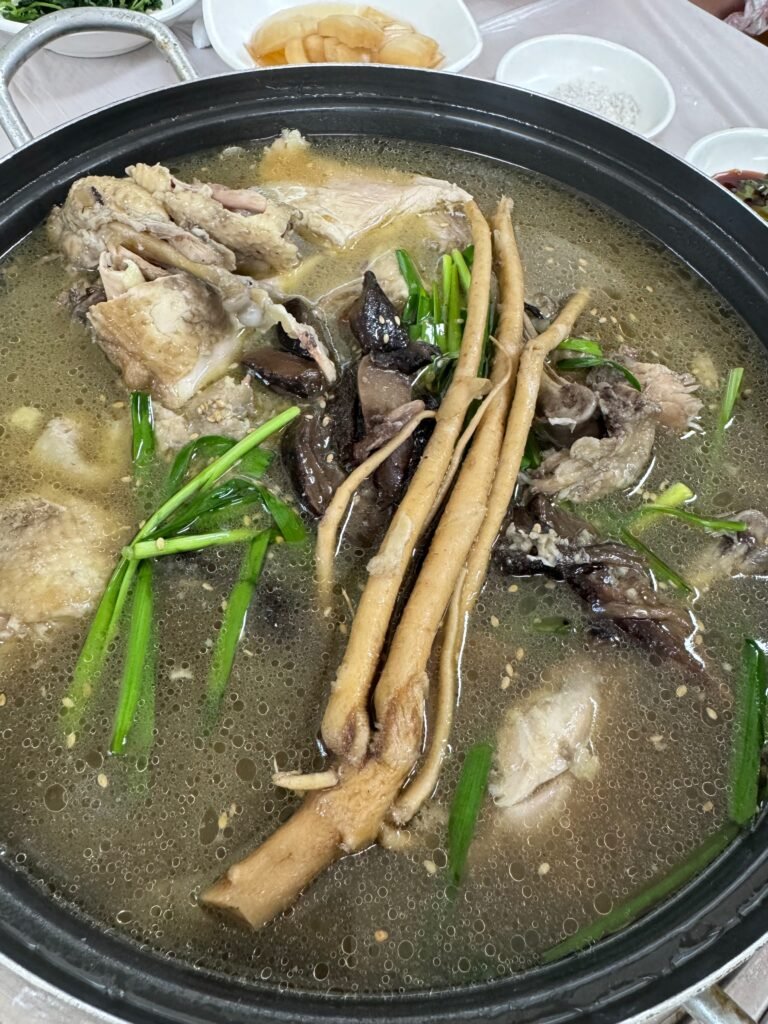
📷 Neungi mushroom baeksuk I had during my summer trip to Korea.
I almost always go to Korea in the summer, so baeksuk has to be first on my list.
It’s basically a whole chicken slowly cooked until the meat gets really tender. There are different kinds, but neungi mushroom baeksuk is the one I like.
And yes, I know.
Eating a steaming hot chicken dish when Korea is already hot and humid sounds a little crazy.
But there’s actually a Korean idea called “iyeol chiyeol” (이열치열) — basically, fighting heat with heat.
During the hottest part of summer, especially around Sambok (삼복), it’s common to eat nourishing chicken dishes like baeksuk.
It’s one of those Korean summer things that makes perfect sense to me but might seem completely backwards if you didn’t grow up with it.
And because I’m usually there in the summer, I end up craving it every time I go back.
2. Makguksu (막국수)
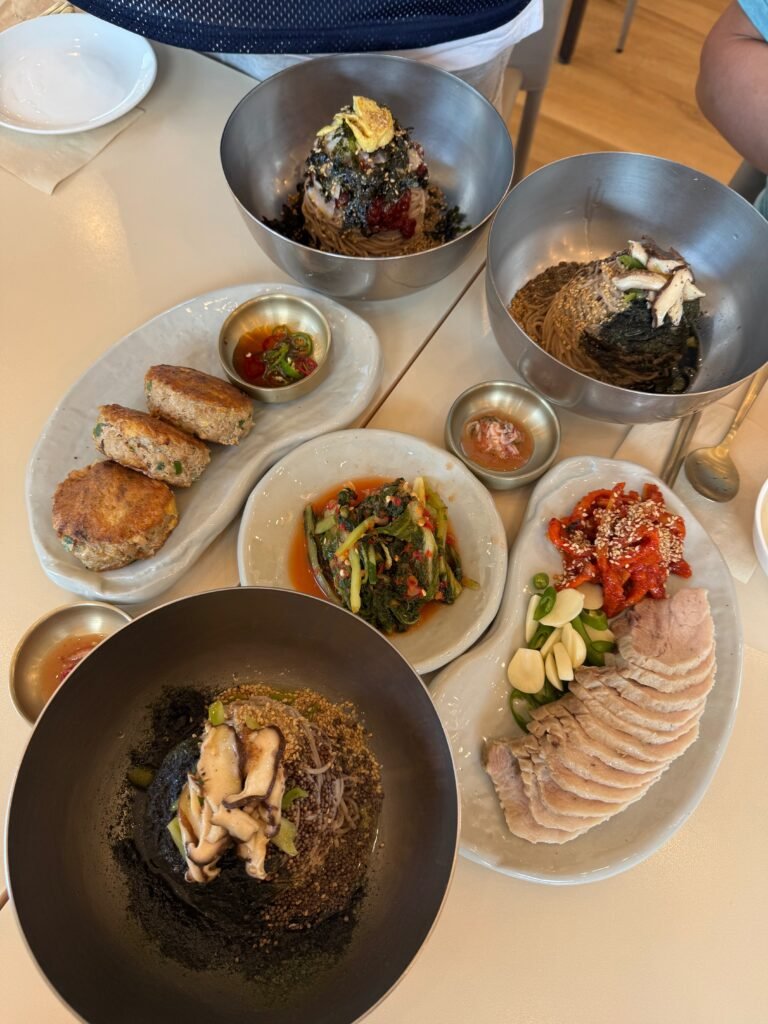
📷 A cold bowl of makguksu — one of my favorite foods during a hot Korean summer.
Then there’s makguksu.
Makguksu is made with buckwheat noodles and is especially well known in Gangwon Province. Depending on where you eat it, it can come with broth or mixed with a spicy sauce.
This is exactly the kind of food I want when Korean summer weather gets really hot.
It’s cold, refreshing, and not as heavy as a lot of other Korean meals.
Makguksu sometimes gets overlooked on the typical Korean food lists written for tourists, which is kind of a shame.
If you’re in Korea during the summer, you’ll understand why people eat so many cold noodles.
3. Naengmyeon (냉면)
Speaking of cold noodles, obviously I have to include naengmyeon.
There are two main versions you’ll see a lot.
Mul naengmyeon (물냉면) comes in an icy cold broth.
Bibim naengmyeon (비빔냉면) is mixed with a spicy sauce and usually has little or no broth.
They taste completely different even though they’re both naengmyeon.
One thing that might seem a little random at first is that people also eat naengmyeon after Korean BBQ.
Hot grilled meat followed by a bowl of freezing cold noodles.
It sounds like a strange combination when I actually write it out like that, but it works.
4. Yukhoe (육회)
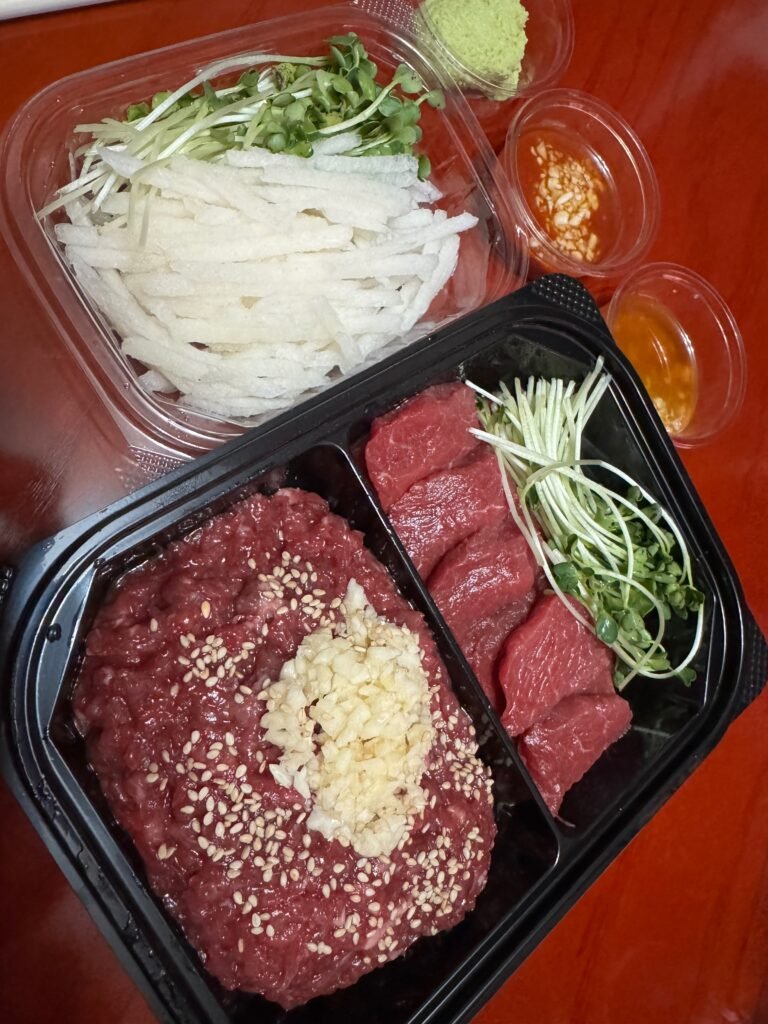
📷 Yukhoe served with Korean pear — something I always enjoy when I’m back in Korea.
Okay, this one isn’t going to be for everyone.
Yukhoe is seasoned raw beef.
It’s usually sliced into thin strips and often served with Korean pear and egg yolk.
I eat yukhoe pretty often when I’m in Korea, and I really like the combination with Korean pear. The pear adds this cold, crisp sweetness that goes really well with the beef.
If you already like steak tartare, this probably won’t seem that unusual to you.
If you’ve never eaten raw beef before… well, this might be a bigger first step. 😂
Since it is raw beef, though, I’m picky about where I eat it. I’d rather have it somewhere reputable than randomly choose a place just because I see it on the menu.
5. Yang Kkochi (양꼬치)
Here’s where my list stops being a strictly “Korean food” list.
Yang kkochi means lamb skewers, and no, lamb skewers didn’t originate in Korea. They’re associated with Chinese cuisine and have become really popular in Korea.
I ate yang kkochi again on my most recent trip.
A lot of places have little grills built into the table, and the skewers rotate over the heat while they cook.
That’s part of why I wanted to include this.
When you actually go out to eat in Korea, people aren’t sitting around eating only traditional Korean dishes every day.
Korea has its own version of going out for lamb skewers, and it’s become a pretty normal part of the food scene.
This list is about what I actually eat there, so yang kkochi stays.
6. Gopchang (곱창)
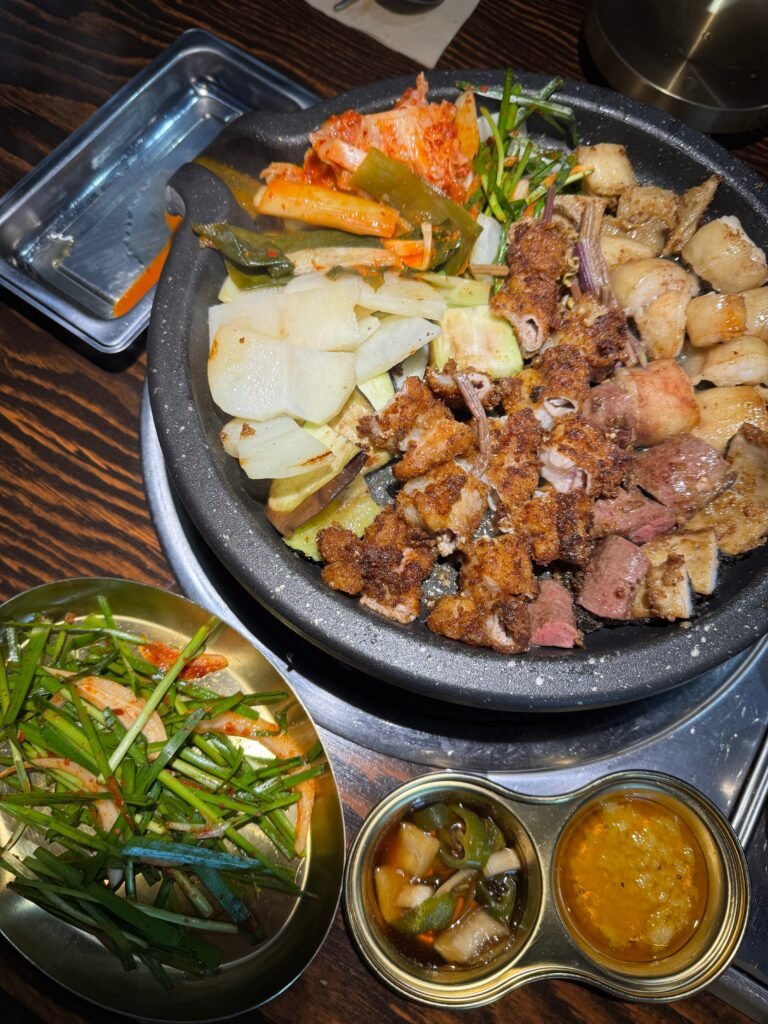
📷 Grilled gopchang in Korea. This one is always on my food list.
Gopchang is non-negotiable for me. 😂
It’s usually grilled beef or pork intestines, depending on what you order.
I realize the word intestines may have already lost some of you.
But hear me out.
Gopchang is rich, chewy, fatty, and completely different from regular Korean BBQ. There are restaurants in Korea that specialize in gopchang and other similar cuts, so it’s really its own kind of night out.
This is definitely one of the foods I look forward to when I go back.
If you’re not an adventurous eater, I completely understand skipping this one.
More for me.
7. Donkatsu (돈까스)
Donkatsu is such a normal food in Korea that I wanted to put it on here even though it isn’t originally Korean.
It came from Japanese tonkatsu, but donkatsu has been part of Korean food culture for a long time and Korea has developed its own versions of it.
Some places serve the thick Japanese-style cutlet, while the old-school Korean version tends to be thinner and wider with sauce poured over the top.
Usually there’s rice, cabbage salad and a few sides with it.
It’s not exciting in the same way as raw beef or gopchang.
It’s just good.
And sometimes that’s exactly what I want.
8. Hoe (회)
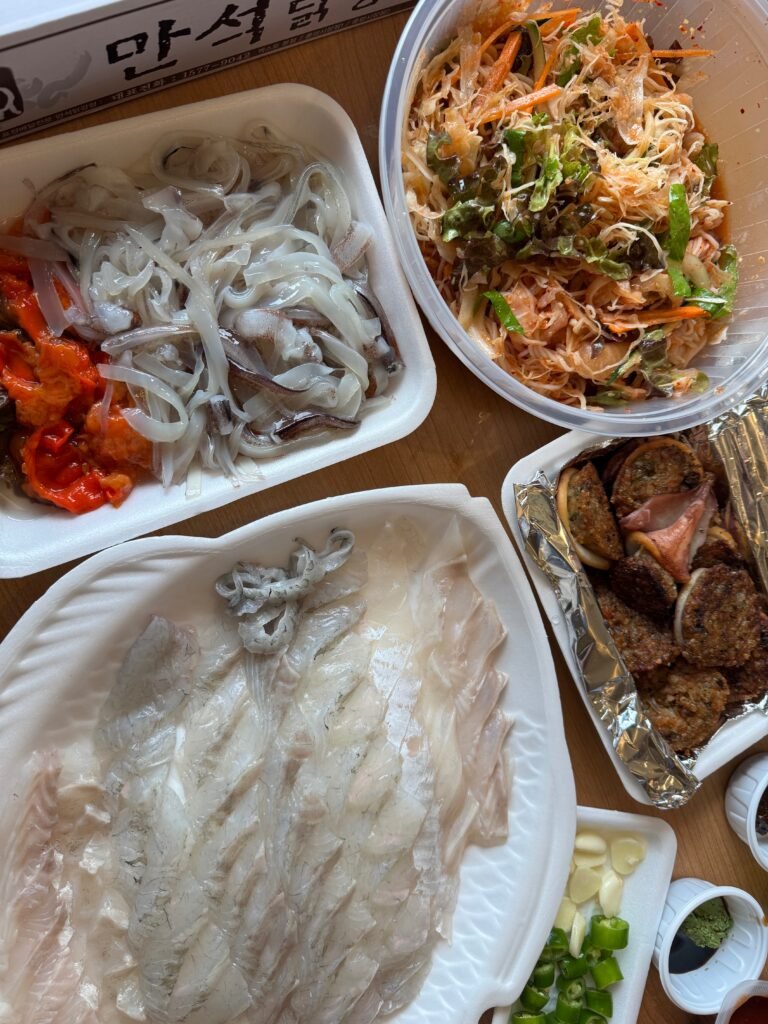
📷 Korean-style hoe with all the sides that make the experience completely different.
I eat hoe, or Korean-style raw fish, when I’m in Korea too.
If you’ve only had sashimi at Japanese restaurants in the U.S., eating raw fish at a Korean restaurant can feel a little different.
It’s not necessarily just fish on a plate.
Depending on the restaurant, you may get vegetables, garlic, chili peppers, sauces and a whole bunch of side dishes with it.
You can also take a piece of fish, put it on a lettuce or perilla leaf, add garlic or sauce, wrap the whole thing up and eat it together.
Same raw fish idea. Very different experience.
9. Jangeo Gui (장어구이)
Jangeo gui is grilled eel, and this is another food I like eating when I’m back in Korea.
The eel can be grilled simply or seasoned with sauce depending on the restaurant.
It’s rich and soft inside, and I especially like that slightly grilled texture on the outside.
Eel is also traditionally considered a nourishing food in Korea, so it fits right in with the whole Korean summer idea of eating something hearty to get your energy back.
It’s one of those foods I don’t really think about much while I’m in the U.S., but when I’m in Korea, I eat it.
10. Muppyeo Dakbal (무뼈닭발)
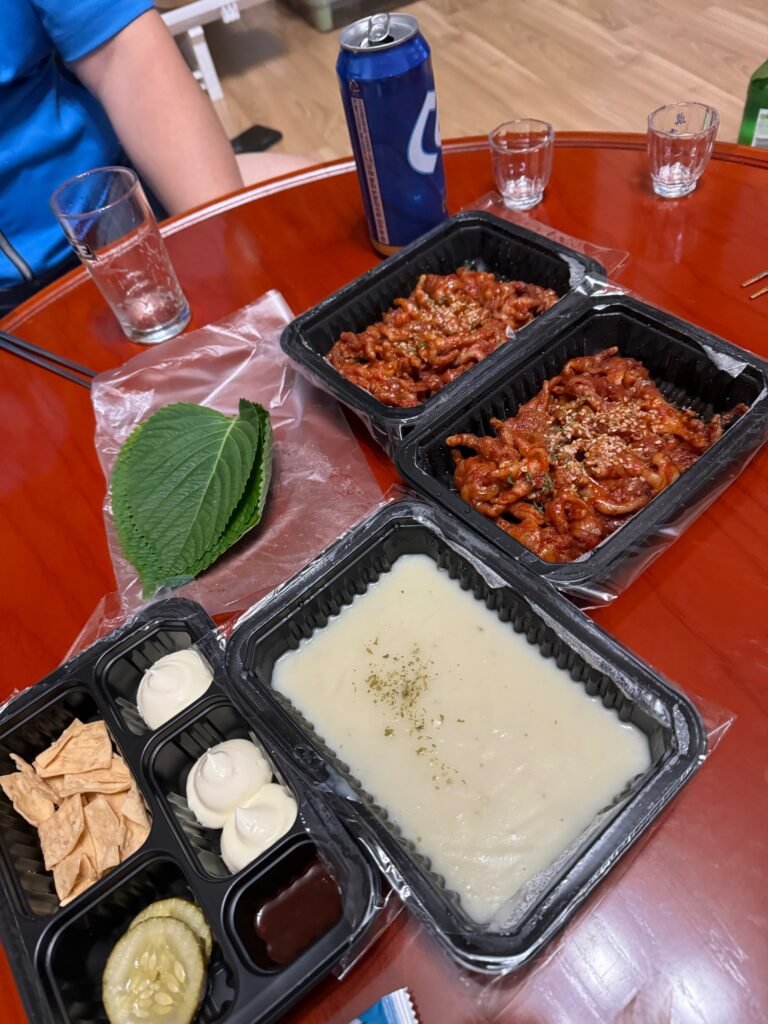
📷 Spicy boneless dakbal. Definitely not mild — and that’s the point.
We’re ending with chicken feet. 😂
More specifically, boneless chicken feet.
Dakbal (닭발) literally means chicken feet, and muppyeo dakbal (무뼈닭발) is the boneless version.
And it is SPICY.
Not “a little Korean spicy.”
It can be the kind of spicy where you know you should stop eating it… and then you take another bite anyway.
I prefer the boneless version because I don’t want to deal with the bones. It’s just easier.
Dakbal is also commonly eaten as an anju (안주), which basically means food you eat while drinking alcohol.
If spicy food is your thing, this is where I’d start getting a little more adventurous than tteokbokki.
So… Where’s the Korean BBQ?
I know.
A Korean food list without Korean BBQ, kimchi or bibimbap probably looks a little strange.
But that’s kind of the point.
There are already thousands of articles telling you to eat those foods in Korea, and they’re not wrong. If it’s your first trip, go eat Korean BBQ. Try real Korean kimchi. Get tteokbokki from a street stall.
But Korea has so much more food than the dishes that became famous outside of Korea.
I go back almost every summer, and these are the things I actually want to eat when I’m there.
Some are traditional. Some are summer foods. Some came to Korea from other cuisines and became part of the way people eat there. And some — looking at you, gopchang and dakbal — might take a little courage.
That feels a lot more like the Korea I actually know than another list of the same ten famous dishes.
So if you’re planning a trip to Korea, try the famous stuff.
But leave a few meals open.
Sometimes the random meal you didn’t plan ends up being the one you remember.